Pruning
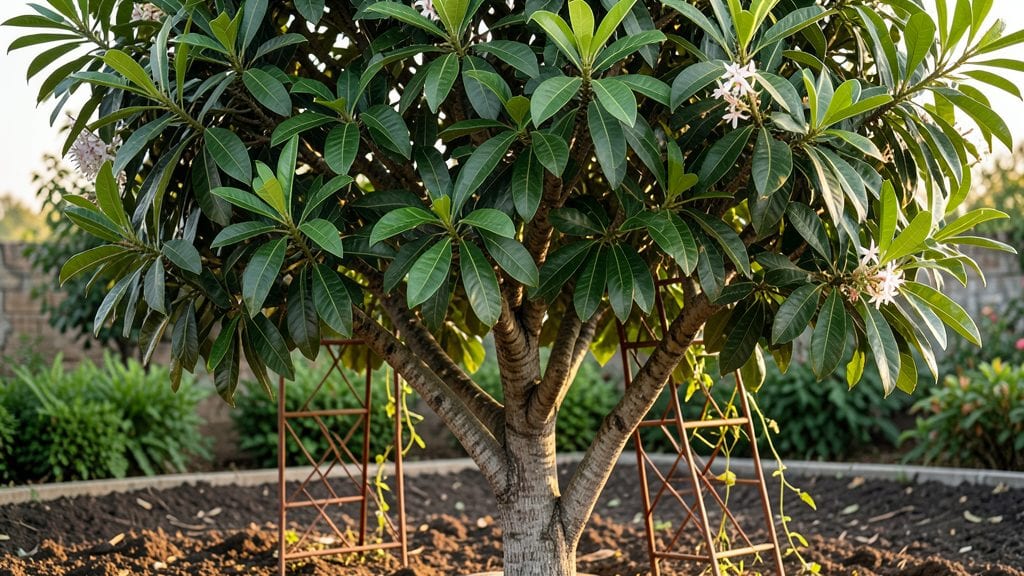
Identifying a mango tree starts with its distinctive oval leaves that feel leathery and glossy—like running your fingers over a polished stone. 🌿 The edges curve gently, and the veins branch out in a pattern that’s unmistakably tropical.
I’ve learned to spot them by noticing how they cluster at the ends of branches, forming a dense, almost umbrella-like canopy that’s perfect for shade.
Look closer at the bark, which develops deep grooves as the tree matures, creating a textured surface that feels rough to the touch.
Young trees have smoother trunks, but even then, the fruits give it away—mangoes hang in clusters, their shapes ranging from round to oval, with skin that shifts from green to vibrant yellow, orange, or red as they ripen.
Common varieties like ‘Haden’ or ‘Kent’ have slightly different fruit shapes, but the leaves stay consistent.
You’ll also notice the tree’s fast growth habit, with branches that spread outward and upward, creating a broad, rounded silhouette. The flowers appear in spring as small, fragrant clusters, but the real giveaway is the scent—ripe mangoes release a sweet, tropical aroma that’s impossible to ignore.
Once you spot these clues, you’ll never confuse a mango tree with its look-alikes, like the related but very different sapodilla or jackfruit.
For gardeners, this knowledge is a game-changer—it means you can confidently plant, prune, or even propagate a mango tree knowing exactly what you’re working with. The next step? Learning how to care for it so those glossy leaves and fragrant fruits become a staple in your landscape.
📚 In This Guide
- What you need
- Instructions
- Tips and common mistakes
- Wrapping up and next steps
What you need
- ● Hand lens or magnifying glass (5x–10x magnification) – for examining fine details like leaf veins or tiny fruit hairs.
- ● Notebook & pen – to jot down observations like leaf shape, fruit color, or bark texture.
- ● Camera or smartphone – to capture close-ups of leaves, flowers, or fruit for later comparison.
- ○ Gloves (optional but recommended) – if handling thorns or exploring dense foliage.
- ● Small pruning shears or scissors – for safely snipping a leaf or small branch (if needed for closer inspection).
- ● Field guide or mango tree identification app (e.g., PictureThis or PlantNet) – for cross-referencing your findings.
- ● Measuring tape – to note leaf length/width or branch spacing (mango leaves are typically 6–16 inches long!).
- ● Ruler or caliper – for precise measurements of leaf thickness or fruit diameter.
- ● Scent detector (your nose!) – ripe mangoes emit a sweet, tropical aroma—let it guide you!
- ● GPS or mapping tool – if identifying wild mangoes in unfamiliar terrain.
Step-by-Step guide to identifying a mango tree
Here's how I spot a mango tree in seconds—no fruit needed. Just look for these key features.
🌿 Step 1: Examine the Leaves for Classic Shape
The first clue is the leaves—long, glossy, and pointed like a spear. Mango leaves are 5-10 inches long with smooth edges and a deep green color. Run your fingers along the leaf edge: if it feels waxy and slightly leathery, you're on the right track. Young leaves start as red or purple before turning green.
Look for the vein pattern too. Mango leaves have a single prominent midrib with smaller veins branching out like fingers. Hold a leaf up to light—you'll see the veins form a clear, symmetrical pattern. If the leaf feels thin or has jagged edges, it's probably not a mango.
🌱 Step 2: Check the Growth Pattern and Bark
Mango trees grow in a distinctive way. The trunk is often crooked or irregular, with rough, dark gray bark that flakes slightly over time. Young branches grow outward at sharp angles, creating a wide, spreading canopy. If you see a tree with a perfectly straight trunk and smooth bark, it's likely not a mango.
Look at the branch structure too. Mango trees have a habit of growing in clusters, with multiple trunks or thick branches emerging from the base. The leaves grow in pairs along the branches, not singly like many other fruit trees. This clustered growth is a dead giveaway.
🍈 Step 3: Look for Fruit Clues (Even If Not Ripe)
Even unripe mangoes have distinctive features. The fruit grows in pairs or small clusters, and the skin is smooth with a slight waxy feel. When young, mangoes are green but often have a faint blush or red tint near the stem. The shape is oval or kidney-bean-like, never round like an orange or apple.
Check the flower scars too. Mangoes leave behind a small, circular scar where the flower was attached. This scar is usually raised and can be felt with your fingernail. If you see these scars on the fruit, you've found a mango tree. The presence of these scars is one of the most reliable indicators.
✂️ Step 4: Test the Smell and Taste (When Possible)
If you can safely reach a fruit, give it a sniff. Mangoes have a sweet, tropical aroma even when unripe. The scent is faint but unmistakable—like a mix of citrus and floral notes. If the tree smells strongly of pine or resin, it's not a mango.
For a taste test, take a small bite from the fruit. Even unripe mangoes have a mild sweetness with a hint of tartness. The texture is firm but slightly fibrous. If the fruit tastes bitter or sour without any sweetness, it's not a mango. This step is the final confirmation, but it's only possible when fruit is available.
Tips & tricks for identifying a mango tree like a pro
Ready to become a mango tree detective? These pro tips will help you spot one with confidence, even when there's no fruit in sight.
Leaf Texture is Your Best Friend: In Step 1, when examining leaves, pay extra attention to how they feel. Mango leaves should be thick and leathery—almost like a slightly waxy piece of paper. If you can't feel that texture, it's not a mango. I've learned this the hard way after mistaking papaya trees for mango trees in tropical regions.
Bark and Branch Structure Tell the Story: For Step 2, focus on the bark's rough texture and the tree's growth pattern. Mango trees often have multiple trunks or thick branches emerging from the base, creating that distinctive clustered look. I once saw a perfectly straight trunk and immediately ruled out mango—it turned out to be a citrus tree!
Flower Scars Are Game-Changers: When checking fruit in Step 3, don't overlook those tiny flower scars. These raised circular marks are like fingerprints for mango trees. I've used this trick to identify mango trees in markets where fruit was the only visible clue. Run your fingernail over the scar—if it feels slightly raised, you've found your tree.
Seasonal Clues for Identification: Timing matters! In tropical regions, mango trees often have new leaves appearing in spring that start red or purple. If you're visiting during this time, look for these vibrant young leaves—they're a dead giveaway. This seasonal pattern has helped me identify mango trees even when no fruit was visible.
Pro Tips for Identify Mango Tree
- Ready to become a mango tree detective?
- Leaf Texture is Your Best Friend: In Step 1, when examining leaves, pay extra attention to how they feel.
- Bark and Branch Structure Tell the Story: For Step 2, focus on the bark's rough texture and the tree's growth pattern.
Frequently asked questions
Got questions about spotting a mango tree? You’re not alone! Here are answers to the most common queries—whether you’re a gardener, traveler, or just curious about tropical trees.
How can I tell if a small tree is a mango tree before it bears fruit?
A young mango tree can be tricky, but look for compound leaves with 5–9 leaflets (like a feather) and a reddish-brown stem when scratched. The leaflets also have a waxy, slightly leathery texture. If the bark is smooth and grayish with small, raised lenticels (tiny dots), it’s a strong clue!
When is the best time of year to identify a mango tree by its leaves?
Spring and early summer are ideal! That’s when mango trees flush new growth—young leaves are vibrant, and the leaf arrangement (alternate, spiraling) is easiest to spot. Avoid winter, when some trees drop leaves or look dormant.
What if the tree has leaves that look like mango but no fruit? Could it be something else?
Yes! Trees like sapodilla (chico sapote) or jackfruit have similar compound leaves. Check for these differences:
- Mango: Leaflets are asymmetrical at the base (uneven sides).
- Sapodilla: Leaflets are symmetrical and the tree has a sweet, resinous sap.
- Jackfruit: Leaves are larger and more glossy, with a spicy aroma when crushed.
What should I do if I think a tree is a mango but it’s not producing fruit?
Mango trees need full sun (6+ hours/day), well-draining soil, and consistent watering (but no soggy roots!). If it’s young (<5 years), it may not fruit yet. For older trees, check for:
- Pollination: Mangoes need cross-pollination (plant 2+ trees or hand-pollinate).
- Fertilizer: Use a balanced citrus/mango fertilizer in spring.
- Avoid over-pruning: Heavy trimming can stress the tree and delay fruiting.
Can I identify a mango tree by its bark alone, or do I need to see the leaves?
Bark gives some clues but isn’t foolproof. Mature mango bark is grayish-brown, rough, and deeply furrowed with age. However, many trees (like peach or citrus) develop similar textures. Always check the leaves—their shape and arrangement are the most reliable ID markers!
Wrapping up and next steps
Identifying a mango tree is easier than you think—just follow the leaf shape, bark texture, and fruit traits we’ve covered! 🌿 Whether you’re a gardening newbie or a seasoned plant enthusiast, spotting these clues will help you confirm your find with confidence.
Now that you’re equipped with the know-how, why not take the next step?
🌱 Your Next Move:
- Plant your own! If you’ve spotted a mango tree, consider growing one—whether from a seed or a grafted sapling.
- Share the knowledge. Help fellow gardeners by tagging us in your mango tree discoveries!
Happy identifying—and may your future harvests be sweet and plentiful! 🍈✨